The DeCA is now mandatory: what it is, who has to carry it and how to start today
Since 5 October 2026 every public goods-transport shipment in Spain needs its electronic DeCA with a QR code. What the rules say (Ley 9/2025, Orden FOM/2861/2012), who is obliged, the real-world questions —own fleet, several delivery notes, courtesy DeCA, collections— and how to get started in a day with JobDeca.
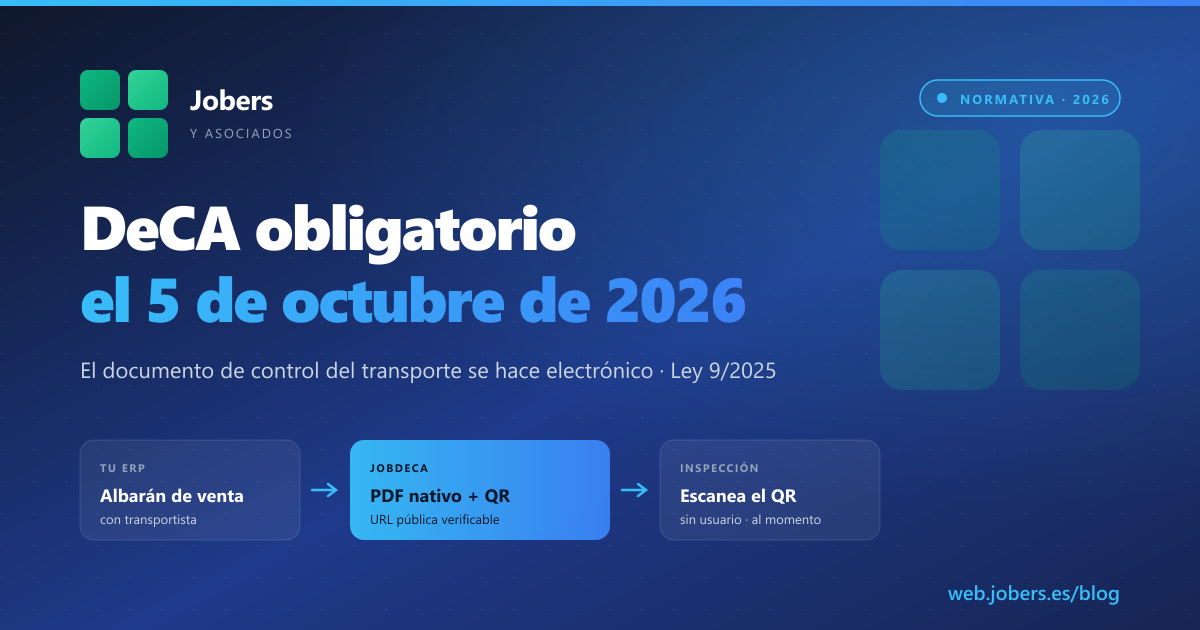
As of today, 5 October 2026, the DeCA is mandatory in Spain. The DeCA (Documento electrónico de Control Administrativo), Spain’s electronic transport control document, replaces the paper control document that has accompanied hauls since 2013: every domestic public road-transport shipment of goods must be covered by an electronic document with a QR code, which inspectors open at the roadside on their phone.
If your company sells materials and hires carriers to deliver them, this affects you now. And if you have not sorted it out yet, the good news is that you can start today: further down we explain how to get going in a single day. At Jobers we saw it coming and developed JobDeca, which is already issuing DeCAs every day. But first, the important part: what the rules say and whether they apply to you.
Not issuing the DeCA yet?
We set you up and you issue them manually from day one, while we integrate your management software.
I want to start todayWhat the DeCA is, in one sentence
It is the document that identifies each shipment of public goods transport: who contracts the transport (the contracting shipper), who carries it out (the carrier), what is being transported, how much it weighs, where it leaves from, where it is going and in which vehicle (number plate and trailer). Until now it could be a piece of paper in the cab; since 5 October 2026 it must be electronic, natively digital and carry a QR code.
The legal framework, no beating about the bush
Three rules make up the puzzle:
-
Orden FOM/2861/2012 — created the control document and set its minimum content: contracting shipper and carrier (company name, tax ID, address), place and date of loading, place of delivery, nature of the goods, weight and number plate (plus the special circulation permit, only if the transport needs one). It also defined the unit: one document per shipment (the goods going from one shipper to one destination).
-
Ley 9/2025 — makes the document electronic and mandatory from 05-10-2026 for domestic transport. It keeps the obligation to retain it for at least one year, for both the contracting shipper and the actual carrier. International transport is excluded (the eCMR applies there).
-
Resolution of 5 June 2026 of the Dirección General de Transporte por Carretera (Spain’s road-transport directorate) — sets the technical requirements: a natively digital PDF (maximum 5 MB; no scanned paper), with a QR code leading to a unique, secure address, downloadable without a username or password so that the officer can open it on the road.
Are you obliged? The key question
The obligation revolves around one concept: public transport, that is, when a carrier is hired to move the goods. In that case, the contracting shipper —usually the distributor who sells the material and hires the haulage— must have the DeCA and retain it, as must the carrier who performs it.
Delivery with your own fleet is excluded, but only if all three conditions are met at the same time: your own goods, in a company vehicle and with a driver on your payroll. We look at this in detail below, because it is the number one question.
Watch out for the nuance that causes most confusion: the obligation is per shipment, not per company. The same distributor who delivers with their own lorry and driver in the morning needs a DeCA in the afternoon for the pallet that goes out with a haulage agency. Each delivery note decides.
Also excluded are the special cases in the Orden: parcel delivery, removals and similar.
What happens if you do not comply
The control document is mandatory transport documentation: travelling without it (or with one that does not meet the technical requirements) exposes both shipper and carrier to the penalty regime of the LOTT (Spain’s land transport act), and inspectors can immobilise the vehicle until the shipment is proven. From today, “I forgot the paperwork” no longer exists: either the QR code responds, or there is no document.
The questions we are being asked most
If we deliver with our own lorries, do we need a DeCA?
If you deliver with your own means —your own goods, in a company vehicle and with a driver on your payroll— it is complementary private transport and is not obliged to carry a DeCA, although you can issue one anyway. If just one of the three conditions fails, for example a company lorry with an external driver, it becomes public transport and the DeCA is mandatory.
A lorry carries several delivery notes: one DeCA or several?
One per delivery note. The rules require one document per shipment (one shipper, one destination): if a lorry leaves with three delivery notes for three customers, that is three shipments and three DeCAs, and the driver carries the three QR codes —printed or on their phone—. There is no such thing as a “DeCA for the lorry”: a single document cannot declare three destinations and three weights. What you can do is give the driver a loading sheet with the three QR codes on a single page, so they do not have to hunt for them one by one.
My customer arranges the transport: do I have to issue the DeCA?
In principle, no: the contracting shipper is whoever hires the haulage, and if your customer hires it (they come to collect with their own carrier), the DeCA is their responsibility. But many small customers are not prepared and ask for it at the loading bay. That is what the courtesy DeCA is for: your company issues the document as a service, and in it your customer appears as the contracting shipper. The document says so, so there is no confusion about who is responsible for what.
If a detail is wrong, can it be corrected?
An issued DeCA is not edited: it is replaced. You correct the detail —the number plate, the weight, the destination—, issue version 2 with its own QR code, and the previous version is marked as replaced: if anyone scans the old QR code, they see that it is no longer valid and a link to the current one. If the transport never takes place, the DeCA is cancelled. And if the lorry changes once the journey has started, the carrier records the change of vehicle (art. 6.g of the Orden), which is printed on the document itself. Crossing out the paper with a pen does not count.
We are collecting material from a supplier with a carrier we hired ourselves. Who issues the DeCA?
You do. Even though the goods leave the supplier’s warehouse, you are the one hiring the haulage, so you are the contracting shipper: the place of loading is the supplier and the place of delivery is your warehouse (or the site). As that movement is not generated by your management software, the DeCA is entered manually: a couple of minutes. And if the weighbridge weight or the lorry changes, the carrier can correct it from their own phone.
Does the driver have to carry the paper?
Not necessarily: the rules allow the DeCA on paper or on the phone screen. What matters is that the QR code can be scanned. The practical approach is a printed loading sheet with all the lorry’s QR codes, plus the PDF of each DeCA on the carrier’s phone.
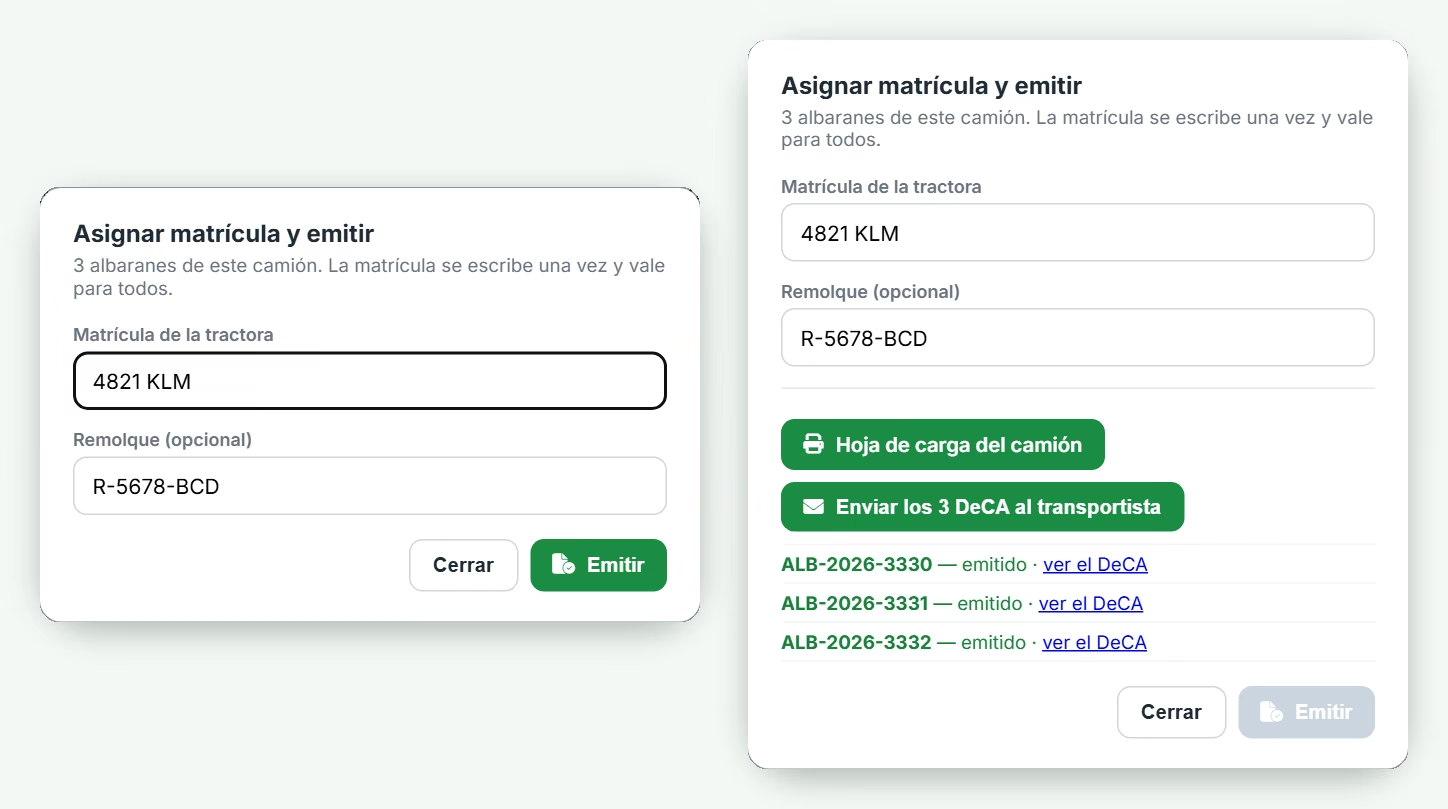
At the loading bay: the number plate is typed once and all the DeCAs for the lorry come out, with their loading sheet (sample data).
If you do not have it yet: how to get started in a day
You do not need to wait until your management software is integrated to comply from today. The path we are following with companies arriving at the last minute:
- Set up the same day. We give you your access; it works on your computer, tablet and phone, with nothing to install.
- Issue manually from day one. With manual entry you create one DeCA per delivery note in a couple of minutes: the issuing company and the shipper are pre-filled, and a search tool remembers carriers, destinations and goods already used. It is exactly the same document as the automatic one.
- Classify your hauls. Which go out with a hired carrier (obliged) and which with your own means —the three conditions— (not obliged)?
- Have the lorry details to hand. The number plates of the tractor unit and trailer are needed when issuing; if the delivery note goes out without them, they are added at the loading bay.
- Give the driver the loading sheet and email the DeCAs to the carrier.
- Integrate your management software at your own pace. Via API, file or email. When a delivery note that was already entered manually arrives automatically, it replaces it: there are never two.
JobDeca: how we solve it
JobDeca solves the DeCA end to end for distributors and manufacturers, and integrates naturally with the Jobers ERP and with any other management software. Since July it has grown a great deal with what we have been asked for at the loading bays:
- Four ways for the delivery note to arrive: the API (your software calls it when the delivery note is saved), a file via SFTP, a mailbox to which the delivery note is forwarded as a PDF, or manual entry. A failure in one delivery note does not stop the others, and if something does not go through, a notification arrives with the reason.
- Designed for the loading bay: a delivery note that arrives without a number plate waits in Pending number plate; you tick the ones on the lorry, type the number plate once and they all come out.
- Loading sheet: a PDF with all the lorry’s QR codes and a summary of each shipment. If the DeCAs were entered manually, the Loading sheets screen groups them by lorry automatically.
- Sending to the carrier: all the lorry’s DeCAs, with the sheet, in a single email; their address is saved for next time.
- Carrier portal: each carrier sees their DeCAs on their phone, logs in with fingerprint or face, and if you allow it corrects the weight or number plate or records a change of lorry en route.
- Risk-free corrections: replace or cancel, never edit; the old QR code warns and links to the current one.
- History of each DeCA: when it has been viewed —for example, at an inspection— and who it has been sent to.
- Native PDF with QR code, retention for at least one year with daily backups on servers in the European Union and optional electronic signature (PAdES/eIDAS) with each company’s seal certificate.
- Several companies in one account, manuals in Spanish, English and French and help via the light bulb in the menu, in the language of whoever is writing.
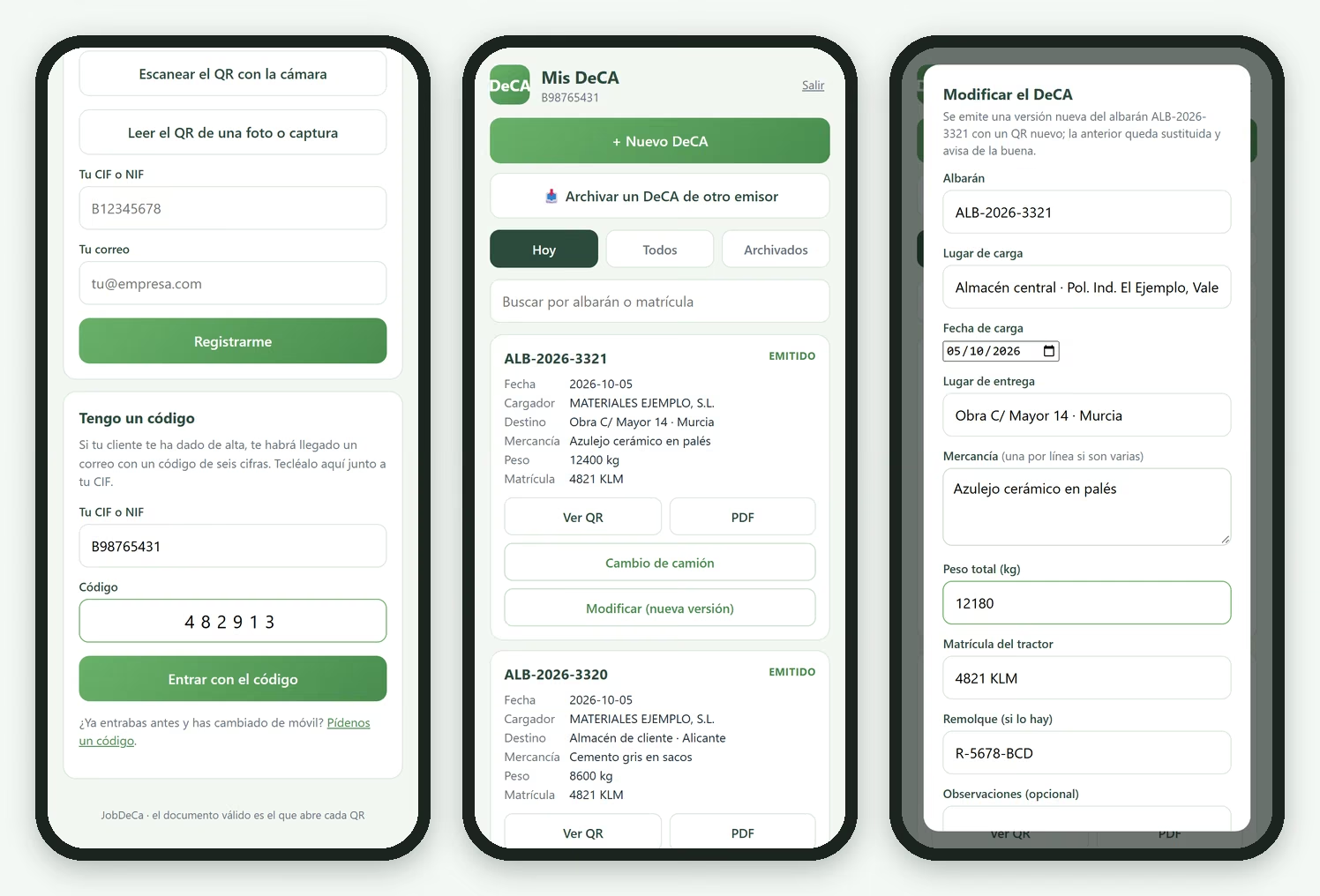
The carrier, on their phone: logs in with a code, sees their DeCAs and corrects en route (sample data).
You can see how it works on the JobDeca page, with the real screens, the video and the manuals, or write to us and we will set you up today so that your next lorry leaves with its DeCA.
Shall we talk about your case?
If you would like to see how Jobers could work in your company, ask us for a no-obligation demo.
Request a demo